Leave Your Message

How to Source Knit Sweaters for Your Business?

Sourcing Knit Sweaters is a product decision, not just a price comparison. A low unit cost can look attractive until a sleeve twists, a cuff loses shape, or the finished color differs from the approved swatch. Fashion designer Vivienne Westwood’s advice, “Buy less, choose well, make it last,” offers a useful lens for the process. For a business, “choose well” means checking the details behind each sample.

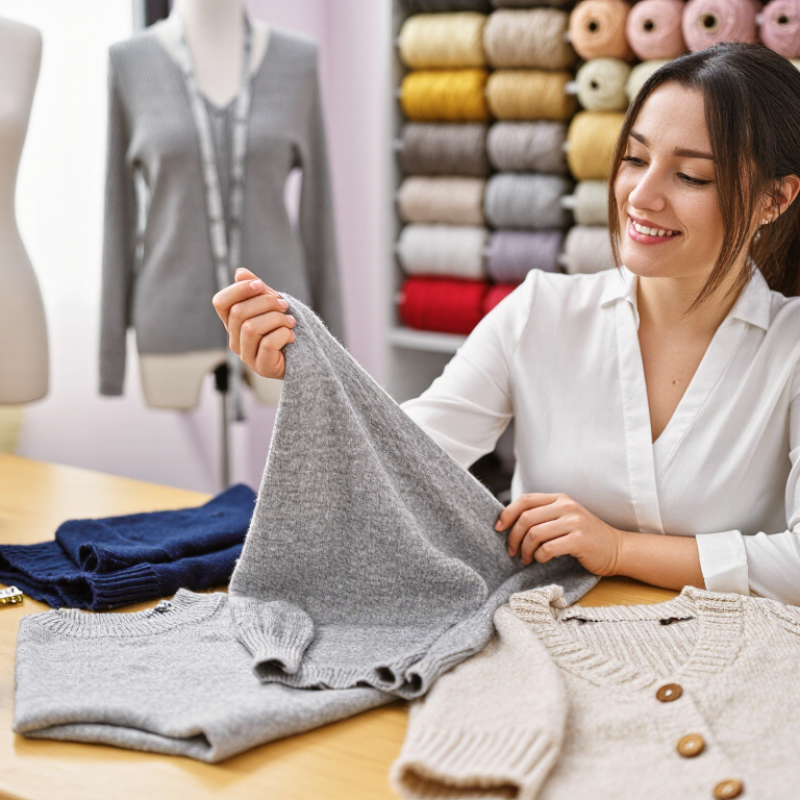
Start with the customer and the intended use. A lightweight merino crewneck needs different yarn, gauge, and finishing from a chunky cotton cardigan. Ask suppliers for fiber composition, measurement tolerances, minimum order quantities, sample fees, and realistic production lead times. Then inspect a physical sample. Feel the fabric, check the seams, and compare measurements after washing. Details matter. A polished photo cannot show how a sweater pills after repeated wear.

This guide explains how to identify suitable manufacturers, assess samples, compare quotes, and plan quality checks before placing a bulk order. It also covers communication: clear tech packs, approved color references, and written change records can prevent expensive misunderstandings. Still, no checklist catches everything. I would ask one more question about finishing, even when a supplier’s answers seem complete. Samples can disappoint. That is part of the work. The goal is not to find a perfect supplier on the first call, but to build a reliable process for choosing Knit Sweaters your customers will want to wear again.
How to Source Knit Sweaters for Your Business?

Set Sweater Specs Against 124 Mt of 2023 Fiber Output (Textile Exchange)

Global fiber production reached 124 million tonnes in 2023, according to Textile Exchange’s Materials Market Report 2024. That figure is a sourcing context, not a sweater recipe: it includes fibers used across many textile products. For a knitwear business, specify fiber content by percentage and identify whether each fiber is virgin, recycled, or otherwise certified. Small details matter.

A clear tech pack should also state yarn count, knit gauge, finished garment weight, measurements, and acceptable tolerances. Ask suppliers to confirm how washing changes length and width; a sweater that fits on the sample table may stretch after wear. Set pilling, seam strength, and colorfastness requirements using agreed test methods, such as ISO 12945 for pilling. This is not a perfect proxy. Test results still depend on construction and finishing.

Match specifications to the intended customer and price point, then approve a production sample before placing a bulk order. Request fiber-content documentation and, where relevant, transaction records for certified materials. Textile Exchange’s global total can help frame material choices, but it cannot verify a particular mill’s claims. Keep the data trail alongside the purchase order, and record any approved substitutions. A rushed substitution can change hand feel, drape, or care needs.

How to Source Knit Sweaters for Your Business? — Set Sweater Specs Against 124 Mt of 2023 Fiber Output (Textile Exchange)
Sourcing Dimension 2023 Fiber-Market Data What to Specify for Knit Sweaters Verification to Request
Global fiber supply context Global fiber production reached approximately 124 million metric tonnes in 2023. Use the figure as market context, not as a measure of sweater-grade yarn availability. Define the required fiber, yarn count, color, volume, and delivery window for each style. Confirm available yarn capacity, minimum order quantities, lead times, and any allocation constraints with the supplier.
Polyester scale Polyester represented approximately 57% of global fiber production in 2023—about 71 million tonnes when calculated from the reported total. If specifying polyester, state the percentage in the finished garment and whether the fiber must be recycled or virgin. Define performance and hand-feel requirements separately. Request a composition test and, for recycled-content claims, appropriate transaction and chain-of-custody documentation.
Cotton scale Cotton represented approximately 20% of global fiber production in 2023—about 25 million tonnes when calculated from the reported total. Specify the cotton percentage, yarn construction, and required fabric or garment performance. For blended sweaters, state each fiber percentage clearly. Check fiber-content test results, colorfastness, dimensional stability, and documentation for any sourcing claims.
Recycled-fiber share Recycled fibers accounted for approximately 7.9% of total global fiber production in 2023, according to Textile Exchange. Set a target recycled-content percentage by fiber type; do not treat a general recycled-fiber market share as proof of recycled content in a specific sweater. Verify the claimed percentage against product-specific documentation and confirm that the evidence covers the relevant supply-chain stages.
Yarn and knit construction Global fiber-output figures describe fiber production, not yarn availability, knitwear capacity, or garment quality. Record yarn count, ply, gauge, knit structure, finished measurements, tolerances, and required sample approval in the purchase specification. Approve a pre-production sample and request measurement, composition, pilling, and care-performance results against agreed requirements.
Data interpretation Fiber percentages and derived volumes are rounded; the derived polyester and cotton tonnages are approximate calculations from the 124-million-tonne total. Use market data to frame sourcing discussions, then base orders on confirmed yarn and factory capacity for the required specification. Compare supplier claims with current documentation and the exact material and production route used for the order.
Source note Market figures: Textile Exchange, Materials Market Report 2024, reporting global fiber production for 2023. Approximate volumes are calculated from the reported total and rounded shares; they may not sum exactly because of rounding.

Choose Fibers with Polyester at 57% of 2023 Global Output (Textile Exchange)

Textile Exchange’s Materials Market Report 2024 estimates that global fiber production reached 124 million tonnes in 2023. Polyester accounted for about 57% of that output. For sweater buyers, this scale means polyester yarn is widely available, but availability alone does not guarantee softness, warmth, or durability. Ask mills for fiber composition, yarn count, and pilling-test results before approving a sample. Feel the cuff after repeated stretching. Small details matter.

A polyester blend can help a sweater keep its shape and dry quickly, while wool or cotton may change its warmth, hand feel, and care needs. Compare actual knit samples, not just fiber labels. Check for surface fuzz, laddering, and uneven stitches under bright light. Textile Exchange also tracks recycled fiber, but recycled content should be verified with supporting documentation. Ask what the percentage refers to: the yarn, the garment, or another stage of production. The wording can be confusing.

Environmental trade-offs deserve attention. UNEP’s 2023 textile value-chain report estimates that textiles contribute 2–8% of global greenhouse-gas emissions; this broad range is not a sweater-specific footprint. Request supplier data and compare like-for-like materials and processes. Do not assume a higher recycled share automatically means better performance. Test it. One fit sample may still miss production variation, so review bulk swatches before placing a larger order.

Screen Knitwear Factories for Capacity, Traceability, and OECD Due Diligence

How to Source Knit Sweaters for Your Business?

Screen Knitwear Factories for Capacity, Traceability, and OECD Due Diligence

A sweater sample shows appearance, not whether a factory can deliver 2,000 pieces on time. Ask for the number of knitting machines, available operators, and current orders by production line. Compare these figures with your order size and delivery window. Check whether the factory relies on outside dyeing, linking, or finishing. These steps reveal where capacity may tighten during peak seasons.

Traceability should reach beyond the sewing floor. Request records connecting yarn lots to spinning mills, dye houses, and finished batches. Review a recent production file, not just a polished policy. A spreadsheet can look complete while a dyehouse remains unnamed. That matters. Ask how subcontractors are approved and monitored, and whether changes are disclosed before production begins.

OECD due diligence is a continuing, risk-based process, not a certificate on a wall. Discuss how the factory identifies labor and environmental risks, prevents or reduces harm, tracks results, and communicates findings. Ask who handles worker concerns and what happens when an issue is found. Keep dated meeting notes and verify corrective actions with records or site visits. No checklist catches everything; gaps in supplier visibility deserve honest follow-up, not a quick green tick.

Set Inspection Plans with ANSI/ASQ Z1.4 Sampling Standards

For knit sweater orders, ANSI/ASQ Z1.4 provides a structured way to inspect a lot without checking every piece. The standard uses lot size, inspection level, and a chosen AQL to determine the sample size and acceptance criteria. AQL is not a promise that every sweater will meet a limit. It is a sampling plan. Small samples matter.

Before production, agree on defect classes and AQL values with the supplier. For sweaters, critical checks may include holes, dropped stitches, seam openings, and incorrect labels. Major issues can include visible yarn snags, uneven ribbing, or measurements outside agreed tolerances. Randomly select units across cartons, colors, and sizes; inspecting only the top layer can miss variation. Record every finding, including garment size and defect location. Keep a few photos. They help clarify disputes later.

Use the sample results to accept, reject, or review a lot according to the chosen plan, and tighten inspection after repeated failures. The plan needs thoughtful setup; a convenient AQL may not reflect the cost of customer complaints. NRF and Appriss Retail’s 2023 consumer returns report estimated that returns represented 14.5% of annual U.S. retail sales. That figure covers retail broadly, not sweaters alone, but it shows why fit and finish deserve attention. Sampling cannot replace clear specifications or supplier follow-up. And it will not catch everything.

Approve Fit, Gauge, and Shrinkage Samples Before Bulk Production

How to Source Knit Sweaters for Your Business?
Approve Fit, Gauge, and Shrinkage Samples Before Bulk Production

A fit sample shows how a sweater behaves on a real body, not just on a spec sheet. Check chest width, body length, sleeve length, and shoulder drop against your size chart. Try it over a light shirt and move your arms. Watch for pulling at the underarm or cuffs that ride up. A sample can look right on a hanger and still feel wrong when worn. Record each requested change with measurements and clear photos.

Gauge affects both appearance and sizing. Ask the factory to knit a swatch using the intended yarn, stitch, and machine setting. Compare the swatch with your approved reference for stitch density, weight, and hand feel. Wash it before approval, too. Knits may relax, curl, or become denser. Changing yarn or gauge later can alter the fit, even when the pattern stays the same.

Test shrinkage using the care method you plan to print on the garment. Measure the sample before and after washing and drying, then note the change in length and width. Test more than one color when yarn dyeing may affect the fabric. Keep the approved sample and measurement sheet together for bulk checks. It is tempting to skip another round when deadlines tighten. That shortcut can be costly, and sample results still may not predict every production variation.

How to Source Knit Sweaters for Your Business?

Approve Fit, Gauge, and Shrinkage Samples Before Bulk Production

Example sample-test results show dimensional change after three wash cycles across three common sweater gauges. Use fit samples to confirm measurements, gauge samples to verify stitch density, and wash-tested samples to check shrinkage before approving bulk production. Actual results vary by yarn, knit structure, and care method.