Leave Your Message

How to Find the Best Knitted Tops Supplier in China?

Finding the right Knitted Tops supplier in China takes more than comparing prices. A low quote may look attractive, but fabric quality, stitching consistency, and clear communication matter just as much. One sample can reveal a lot: check the neckline recovery, seam finish, fabric weight, and how the garment feels after washing. Small details often tell the real story.

A reliable supplier should explain its production process, minimum order quantities, sampling timeline, and quality checks without vague promises. Ask how it handles size grading and color variation, then request a sample before committing to a larger order. Look for relevant product experience and specific examples, not only polished catalog photos. Verify business details and agree on written specifications, including measurements and materials. These steps do not remove every risk. Delays happen. A sample may also differ from bulk production, so define how inspections and corrections will work before manufacturing begins.

The best match depends on your design, budget, order size, and delivery needs. Be candid about your expectations, and notice whether the supplier asks useful questions in return. If communication feels uncertain early on, pause and clarify. A careful search takes time, but it can help you build a more dependable sourcing relationship for Knitted Tops. There is no perfect checklist; judgment still matters.
How to Find the Best Knitted Tops Supplier in China?

Define Your Knitted Tops Requirements and Sourcing Criteria

Defining your knitted tops requirements is the real starting point for sourcing in China. I usually prepare a detailed specification sheet before contacting factories. It should include fiber content, yarn count, knit structure, weight, measurements, colors, trims, and size tolerance. A reference garment or clear technical drawing prevents vague discussions. “Good quality” means different things to different suppliers.

Sourcing criteria should match your product and sales channel. Ask whether the factory handles fine-gauge cotton, chunky wool, blended yarns, or complex jacquard patterns. Request recent production photos, sample records, quality procedures, and export experience. Check minimum order quantities, sampling fees, lead times, payment terms, and packaging methods. A low quotation may hide weaker yarn, limited inspection, or costly revisions. Compare complete costs, not only the unit price.

Insist on a sample before placing bulk production. Test shrinkage, colorfastness, seam strength, pilling, and washing performance. Measure the sample yourself, even when the factory provides a report. Small differences can affect the whole size range. I once underestimated sleeve stretching during fitting, which created avoidable alterations. That mistake taught me to test garments after washing, not only before it. Keep all approvals written, including tolerances and acceptable defects. Reliable suppliers usually welcome precise questions, but communication quality can still change after the first order.

How to Find the Best Knitted Tops Supplier in China?

Define your knitted tops requirements and sourcing criteria before comparing suppliers. The chart uses a neutral 100-point evaluation framework covering quality, materials, order flexibility, delivery, compliance, and communication.

Use these weightings as a practical starting point. Confirm fabric composition, GSM, size tolerance, colorfastness, MOQ, sampling time, bulk lead time, inspection requirements, and applicable testing standards in the final supplier brief.

Identify China’s Knitted Tops Manufacturing Regions and Supplier Types

China’s knitted-top suppliers are concentrated in several textile clusters, but each region has a different strength. Puyuan in Zhejiang is known for sweater production, while Guangdong’s garment centers support varied styles and faster sampling. Jiangsu and Shandong also have established textile and apparel manufacturing bases. The China National Textile and Apparel Council’s 2023 industry review reported that China’s textile sector generated about RMB 4.7 trillion in operating revenue. This figure covers a broad industry, not knitted tops alone. Still, it shows the scale of the supplier ecosystem.

Supplier types vary as much as locations. Large, vertically integrated factories may handle knitting, dyeing, cutting, and finishing under one roof. Smaller workshops can be more flexible for limited runs, but may rely on outside partners for fabric or finishing. Trading companies can coordinate multiple processes, though buyers should confirm who actually makes each stage.
Ask for machine details, sample lead times, minimum order quantities, and recent production references. Visit the workshop if practical. Look closely at seams, rib recovery, and color consistency. Small details matter.

China’s General Administration of Customs reported that textile and apparel exports totaled about US$293.6 billion in 2023. That figure includes many product categories, so it cannot predict a supplier’s capacity for knitted tops. A regional cluster is a useful starting point, not a quality guarantee. Even an attractive sample can hide production limits. Verify capacity with a pilot order, and check whether the factory can repeat the same measurements and finish across batches.

Assess Supplier Experience, Product Quality, and Compliance

A reliable knitted tops supplier should show experience with the styles and materials you plan to order. Ask how long they have produced similar garments, and request photos or samples from recent work. Look closely at necklines, seams, stitch consistency, and how the fabric feels after washing. A neat sample matters, but repeatable quality matters more. One good piece is not proof.

Tips: Request a sample in your intended yarn and gauge. Wash it according to the care label, then check for shrinkage, twisting, pilling, and loose ends. Ask for written inspection criteria and a clear process for handling defects. If answers stay vague, pause.

Compliance deserves the same attention as appearance. Ask which product tests and documents are relevant to your target market, fiber content, and intended use. Confirm that labels match the actual composition, and verify reports with the issuing laboratory when possible. Check whether the supplier can trace yarn batches and keep production records. During a factory visit or video call, observe the knitting floor, storage conditions, and final inspection area. Small details can reveal gaps. I would not treat a polished presentation as evidence by itself; even careful suppliers can miss things, so agree on checks before production begins.

How to Find the Best Knitted Tops Supplier in China? - Assess Supplier Experience, Product Quality, and Compliance

Assessment Dimension Key Evaluation Metric Recommended Benchmark Evidence to Request Weight Score
(1–5)
Supplier Experience Years producing knitted tops At least 5 years of relevant manufacturing experience Business registration, factory profile, production history, and product references 10% —
Product Expertise Experience with comparable knit structures Demonstrated capability in single jersey, rib, interlock, or sweater-knit construction Technical sheets, approved samples, stitch specifications, and fabric test reports 10% —
Production Capacity Monthly output and peak-season capacity Capacity should exceed the planned monthly order volume by approximately 20% Machine list, production plan, capacity statement, and recent delivery records 10% —
Sample Quality Sample accuracy and workmanship Sample matches the specification in measurements, color, hand feel, trims, and construction Pre-production sample, measurement chart, approved color standard, and sample review record 15% —
Quality Control System Inspection process and defect management Documented incoming, in-process, and final inspections; corrective actions recorded Quality manual, inspection checklist, corrective-action reports, and inspection photos 15% —
Defect Control Defect rate and shipment acceptance Use a written AQL inspection plan; AQL 2.5 is a common general-major defect benchmark, subject to buyer requirements Third-party inspection reports, defect classification rules, and shipment acceptance records 10% —
Material Safety Restricted-substance and chemical compliance Materials and accessories comply with the applicable REACH requirements and buyer chemical limits Recent laboratory reports for fabric, dyes, prints, buttons, zippers, and other components 10% —
Certification and Traceability Validity of management and material certificates Valid certificates relevant to the order, such as ISO 9001, OEKO-TEX STANDARD 100, or GRS where applicable Certificate number, scope, issuing body, validity period, and transaction certificates when required 10% —
Social Compliance Labor, safety, and workplace practices No unresolved critical findings; documented controls for working hours, wages, safety, and emergency procedures Recent social-audit report, remediation plan, worker-safety records, and factory policies 10% —
Communication and Reliability Response time, transparency, and delivery performance Clear quotations within 1–2 business days, timely updates, and documented on-time delivery performance Quotation, production calendar, escalation procedure, reference checks, and delivery records 5% —
Commercial Terms MOQ, lead time, payment terms, and total cost Terms fit the order plan without sacrificing quality, compliance, or delivery control Formal quotation, MOQ policy, sample charges, lead-time schedule, Incoterms, and payment terms 5% —
Total Evaluation Weight 100% —
Scoring Guide: 1 = unacceptable evidence or performance; 3 = acceptable with minor gaps; 5 = verified and consistently strong. A supplier should normally achieve at least 80% overall and have no critical failure in product safety, legal compliance, social compliance, or quality control.

Compare Pricing, Minimum Orders, Lead Times, and Communication

How to Find the Best Knitted Tops Supplier in China?

A reliable knitted tops supplier should make costs easy to understand. Compare more than the unit price: ask whether sampling, labels, packaging, and shipping are included. Request a written quote for the same fabric, stitch density, size range, and order quantity from each supplier. A low price can hide thinner yarn or extra charges. Check a sample under natural light and stretch the seams gently. Details matter.

Minimum orders should fit your sales plan, not just the factory’s preferred batch size. Ask whether different colors count separately, and whether sizes can be mixed within one order. For a first run, a smaller quantity may reduce unsold stock, though the price per piece could rise. There is no perfect number.

Get lead times in writing, including sample approval, material sourcing, production, and packing. Build in a buffer for yarn delays or revisions; dates can shift, even with careful planning. Communication is equally important. Send a simple specification sheet and note how quickly the supplier answers questions about measurements, shrinkage, and stitching. A clear reply is useful. A vague promise is not. Keep records of agreed changes, since small details are easy to remember differently.

Verify Samples and Production Capabilities Before Choosing a Supplier

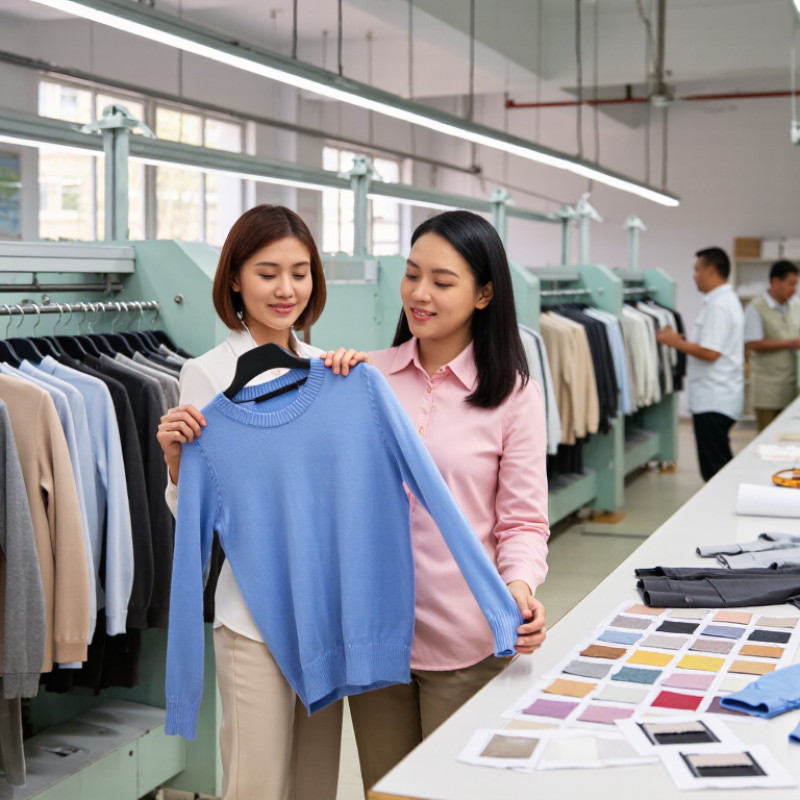
Before choosing a knitted tops supplier in China, request samples made with the yarn, stitch gauge, and finishing method intended for bulk production. A showroom sample may look neat but tell you little about how the fabric behaves after washing. Check the neckline, sleeve seams, rib recovery, and stitch consistency under bright light. Measure key points against the specification, then wash and dry the sample as your customers would. Note any shrinkage, twisting, pilling, or change in handfeel. Small details matter. Ask for a revised sample if the fit or finish misses the mark, and keep written comments with photos. One round may not be enough.

Samples also need to reflect real production capability. Ask what knitting machines and finishing equipment the factory uses, and whether the same setup will handle your order. Request a size set or small pilot run to compare pieces across sizes, not just one carefully prepared sample. Discuss monthly capacity, current production commitments, inspection steps, and how defects are recorded. A clear answer is more useful than a broad promise. If possible, review a live production area or arrange an independent factory assessment. No checklist catches everything; even a strong sample can hide problems that appear at scale. Share your tolerances and delivery needs early, then see whether the supplier flags practical limits instead of agreeing to every request.